What are black holes?
Black holes have captured our collective imagination for decades.
What are they? How do they exist? Does our galaxy really have a supermassive black hole at the centre? Are black holes really holes? In 1975, Stephen Hawking bet his friend and fellow physicist Kip Thorne that black holes didn’t exist.
The simplest answer is black stars are massive stars that when they die they form objects with gravity so strong that not even light can escape their pull, making them appear like we black holes in the fabric of space.
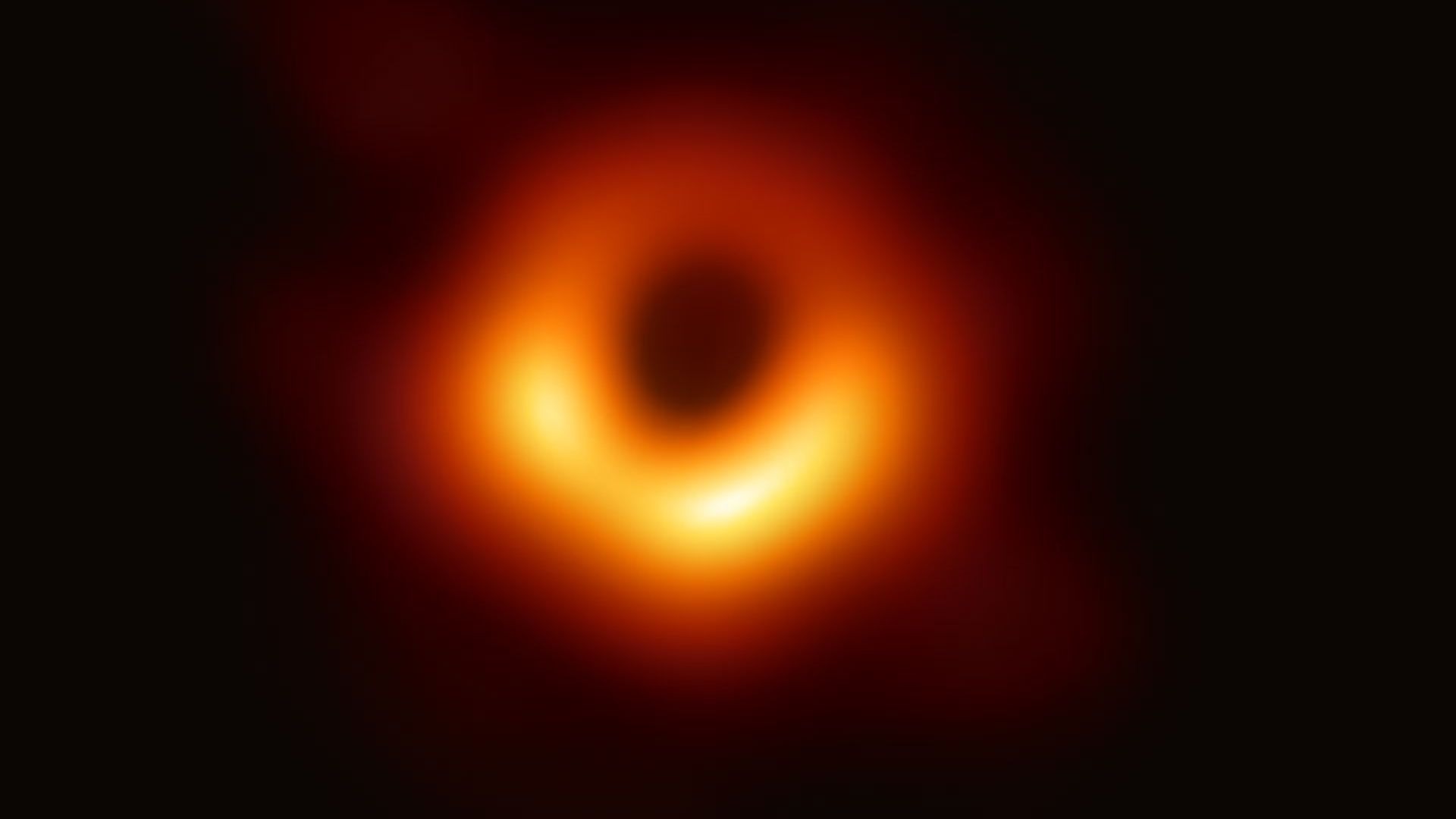
Today, thanks to the pioneering work of the international team behind the Event Horizon Telescope collaboration, we know more about black holes than we ever have before. Read on, and we’ll dive into some facts about these dark and mysterious objects.
But what are black holes?
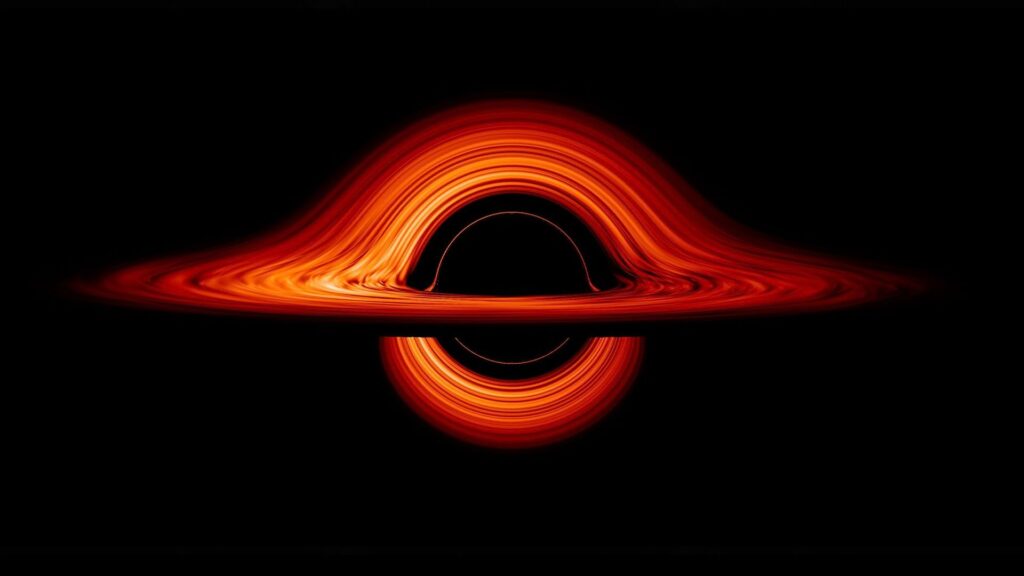
Are black holes really holes in space?
“What is a black hole?” is a million-dollar question, and one that the brightest and best minds of our generation are still working on. But we know that they aren’t literally holes.
A century before Einstein’s theory of relativity, the 18th-century scientist John Michell suggested that a star could be so massive that even light couldn’t escape its pull.
In 1916, Einstein’s theory of relativity helped this make sense. Einstein described our universe as a “fabric” that could be stretched, squeezed, bent and twisted, and Karl Schwarzschild described how a section of spacetime could be so badly warped around a concentrated mass that it would appear to be invisible.
In some cases, stars are so big and their gravitational forces are so massive that they form the extremely dense objects we call black holes. It’s the spherical warped region of space-time that Schwarzschild predicted, where light can’t escape the object’s gravity.
According to Science writer Marcia Bartusiak, the name black hole comes from physicist Robert H. Dicke, who reportedly compared the phenomenon in the early 1960s to the notorious Black Hole of Calcutta dungeon prison.
Are we in danger of being swallowed by the black hole in our galaxy?
Sagittarius A* is about 26,000 light-years away. This is itself a testament to the massive size of our galaxy, which is about 100,000 light-years across.
The Parker Space Probe, launched in 2018, reached a peak speed of around 690,000 km/h. If Parker took a journey to our galaxy’s resident supemassive black hole, maintaining this constant speed (about 0.064% the speed of light), it would take Parker roughly 40.7 million years to reach its final destination.
To put 41 million years into perspective, it’s generally accepted that “anatomically modern humans” emerged in Africa approximately 300 thousand years ago.
Even if our Sun was replaced with a black hole of equal mass, the orbit of Earth and all the planets (and dwarf planets) wouldn’t change. It would have catastrophic consequences for life, but its gravitational pull on Earth wouldn’t change.
How big are black holes?
It’s true that there is a supermassive black hole (SMB) at the centre of our galaxy. In fact, most galaxies probably have one of their own.
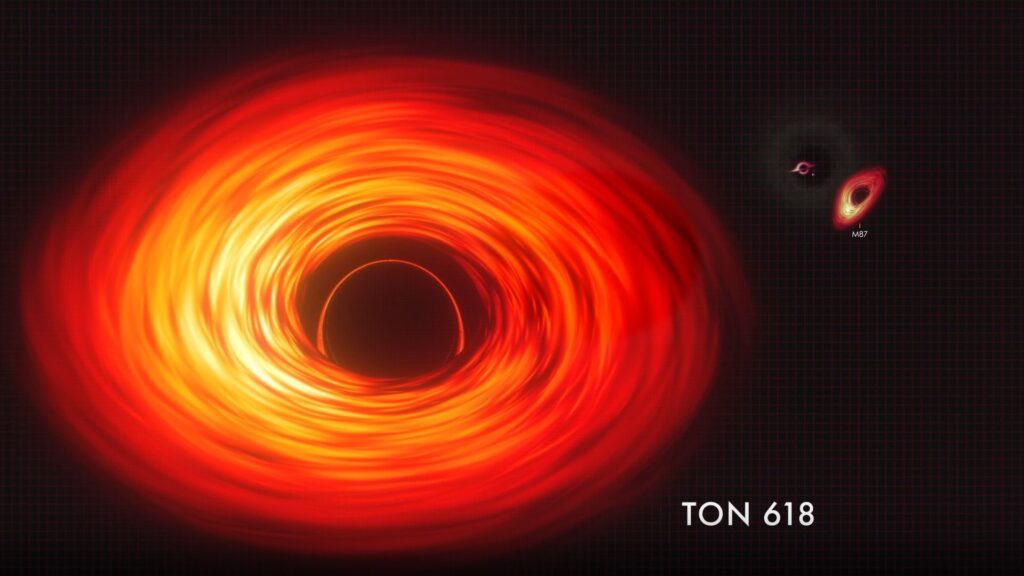
Sagittarius A*, the SMB sitting quietly at the heart of the Milky Way, has a mass equal to about 4.3 million Suns. While Sagittarius A* might sound pretty ‘massive’, in terms of SMB, it isn’t even that big.
Messier 87, the first black hole imaged by the Event Horizon Telescope (EHT) Collaboration, has a rough mass of 5.4 billion Suns. TON 618 contains more than 60 billion solar masses. The object boasts a shadow so large that a beam of light would take weeks to traverse it.
If you want to really feel small, check out NASA’s Animation on the Universe’s Biggest Black Holes.
How are black holes born?
Great minds disagree sometimes. In certain areas, such as the subject of how black holes form, you might find some of that disagreement.
A popular and widely-accepted idea is that when massive stars explode at the end of their lives in an energetic supernova their remains then collapse inward under incredibly intense gravitational forces.
This supernova and collapse form what is generally accepted as a “stellar mass” black hole.
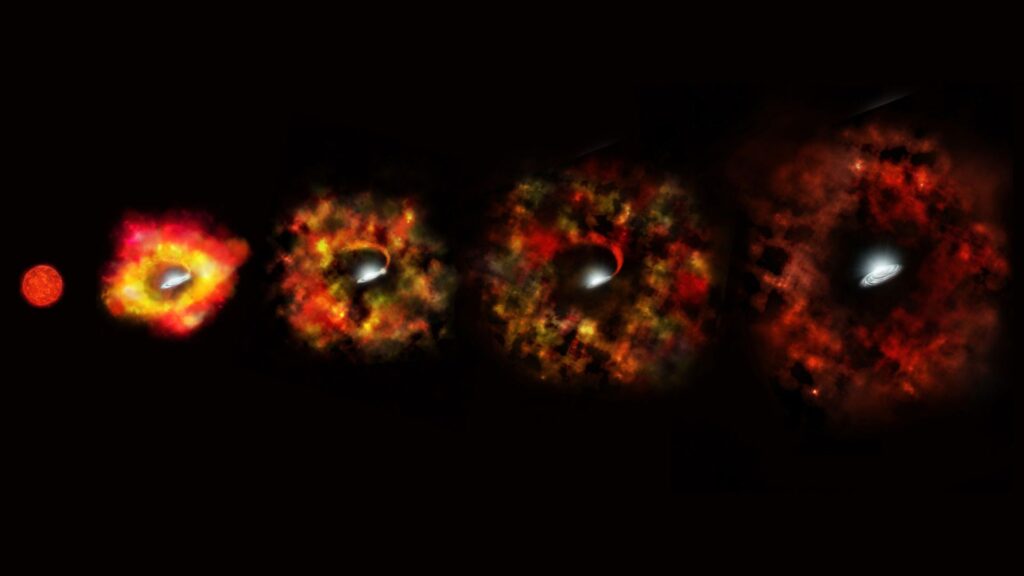
But, occasionally, massive stars don’t explode, surprising astronomers who are watching for a dramatic supernova.
In 2017, astronomers using the Large Binocular Telescope (LBT), and NASA’s Hubble and Spitzer space telescopes watched the star N6946-BH1 disappear.
N6946-BH1 was 25 times as massive as our Sun, but it ended not with a bang, but with a whimper, leaving behind a black hole. Because there are fewer supernovae than astronomers expect, this kind of implosion is considered a possible driver for supermassive black holes.
The subject of primordial black holes is another matter entirely and a discussion for another day
If we can’t see black holes, how do we know they’re real?
Find out more

Jay Chesters
Jay Chesters is an award-winning wordsmith and science communicator with a little bit of a thing for the stars.
A cosmic storyteller with a love for astronomy and space that's out of this world, Jay’s always eager to share his knowledge and passions.