Deep-sky objects (DSO) are astronomy targets that aren’t individual stars, or Solar System objects, like the Sun and Moon, the planets, or comets.
DSO are usually objects such as star clusters, nebulae and galaxies, that are either faintly visible to the naked eye, or visible through a pair of binoculars or a small telescope.
Read on as we take you through our must-see deep sky objects for stargazing beginners.

Carina Nebula (NGC 3372)
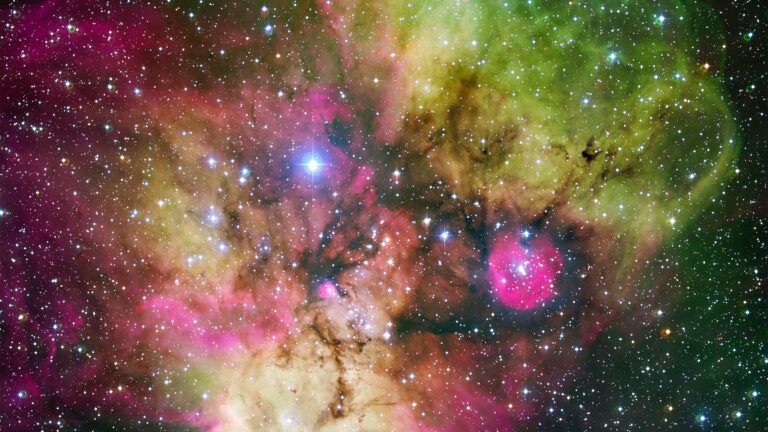
The Carina Nebula (also known as the Eta Carinae Nebula, or the Great Carina Nebula) is a bright, diffuse nebula that you can see with the naked eye.
One of the largest diffuse nebulae known, the deep-sky object is 8,500 light-years away and is about 460 light-years in diameter.
- Visible: February to April.
- Constellation: Carina.

Jewel Box cluster (NGC 4755)
The Jewel Box (also known as the Kappa Crucis cluster) is an open star cluster that appears to the naked eye as a hazy star.
However, through a small telescope or binoculars, this deep sky object resolves into dozens of stars resembling precious, colourful jewels on black velvet.
- Visible: March – June.
- Constellation: Crux.

Andromeda galaxy (Messier 31)
Andromeda is one of possibly two trillion galaxies in the observable Universe. The nearest major galaxy to the Milky Way, Andromeda is 2.5 million light-years away and is the most distant deep-sky object visible to the naked eye.
- Visible: October – December
- Constellation: Andromeda

47 Tucanae (NGC 104)
47 Tucanae (more popularly known as 47 Tuc) is a globular cluster that looks like a a faint patch of stars under very dark skies.
When viewed through a telescope, 47 Tuc reveals breathtaking hot white dwarf stars, low-mass yellowish-red stars, and cool blue stars.
- Visible: September – December
- Constellation: Tucana

Centaurus A (NGC 5128)
Centaurus A is an ideal target for beginner stargazers, and the galaxy’s bright central bulge and dark lane of dust is visible through binoculars.
Astronomers have been fascinated by the galaxy’s peculiar structure for centuries, and it’s thought to have formed from a collision and merger between a large elliptical galaxy and a smaller spiral galaxy.
- Visible: April – June
- Constellation: Centaurus

Tarantula nebula (NGC 2070)
The ESA calls the Tarantula Nebula (also known as 30 Doradus) the “most spectacular feature of the Large Magellanic Cloud”.
You’ll find the nebula on the cloud’s edge, where it’s visible as a bright patch to the naked eye. With a small- to medium-sized telescope, you can see the nebula’s spidery structure.
- Visible: December – February
- Constellation: Doradus

Omega Centauri (NGC 5139)
Omega Centauri is the largest known globular cluster in the Milky Way, and contains approximately 10 million stars.
One of the few globular clusters visible to the naked eye, Omega Centauri appears as a faint, fuzzy star. It gets even better with a small telescope, revealing a breathtakingly vast star field.
- Visible: March – June
- Constellation: Centaurus

Blue Planetary Nebula (NGC 3918)
Also known as The Southerner because of its far southern location, the Blue Planetary Nebula is a compact nebula easily visible with a small telescope.
The deep-sky object is 4,900 light-years from Earth, and the appropriately-named nebula is a great for astronomy beginners, showing off vivid blue, greenish-blue, or blue-green colours.
- Visible: March – May
- Constellation: Centaurus

Southern Pleiades (IC 2602)
The Southern Pleiades (also known as the Theta Carinae Cluster) is a bright, large open star cluster in the Carina constellation and hosts the bright blue-white star Theta Carinae (θ Car).
Visible to the unaided eye, the Southern Pleiades is fainter than the Seven Sisters and is best seen through binoculars. At only 486 light-years away from Earth, the deep sky object is one of our nearest star clusters.
- Visible: March – May
- Constellation: Centaurus

Large Magellanic Cloud
The Large Magellanic Cloud (often abbreviated LMC) is is a dwarf galaxy and satellite of the Milky Way.
Visible to the naked eye as a bright smudge under dark skies, and covering an area 400 times larger than the Full Moon, binoculars helps bring the galaxy to life.
Despite being named after Portuguese coloniser Ferdinand Magellan, Magellan wasn’t an astronomer, and he didn’t discover the galaxy. The Large and Small Magellanic Clouds have been documented by the world’s first astronomers for millennia before Europeans reached the Southern Hemisphere.
- Visible: December – March
- Constellation: Centaurus

Jay Chesters
Jay Chesters is an award-winning wordsmith and science communicator with a little bit of a thing for the stars.
A cosmic storyteller with a love for astronomy and space that's out of this world, Jay’s always eager to share his knowledge and passions.
See deep sky objects
from astrotourism towns