2026 has some unmissable meteor shower highlights for sky-watchers in the Southern Hemisphere.

Shooting stars favour patient stargazers, and we’ve collected the essential info for West Australian skies to prepare skywatchers and amateur astronomers alike for where to look and what to expect.
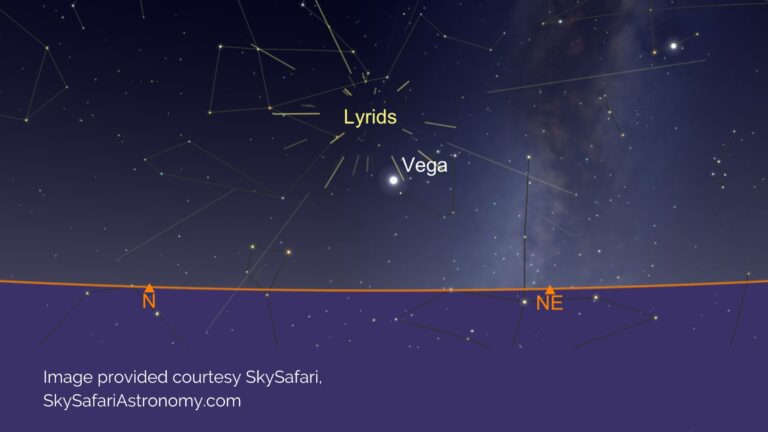
The Lyrid meteor shower on 23 April before 4am. Astronomical images provided by SkySafari, a Simulation Curriculum Company, All rights reserved www.simulationcurriculum.com.
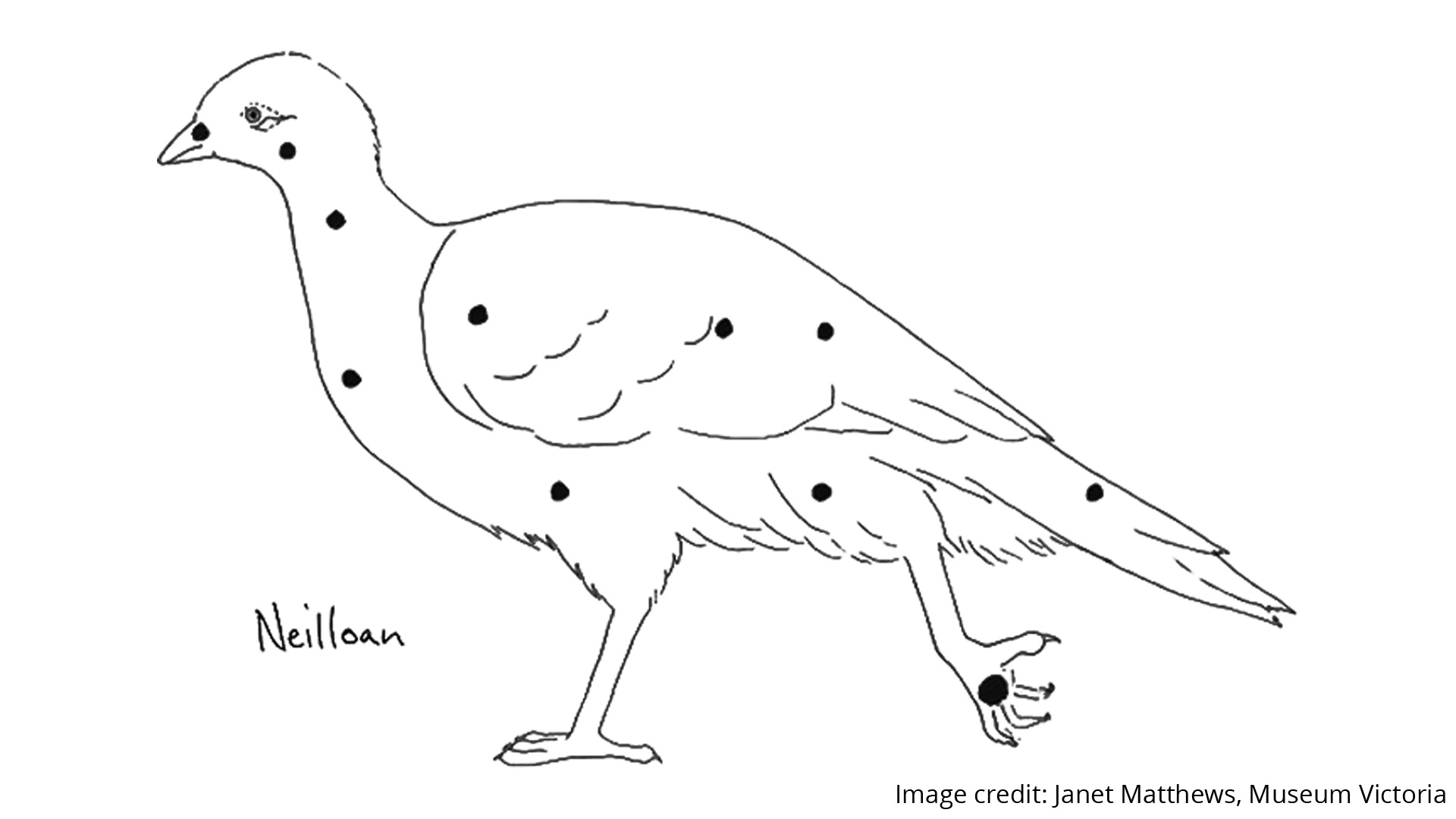
Image shows Neilloan, the Malleefowl, which is based around Vega, the fifth brightest star in the night sky. Neilloan is far to the north.
For the Boorong people, the constellation of Lyra is Neilloan is the Malleefowl. Image credit: Janet Matthews, Museum Victoria.

The Lyrid meteor shower lasts from April 14 to 30, peaking around 3.30am on 23 April 2026.

What to expect in 2026
This meteor shower is slow to start, with hourly rates increasing sharply close to the peak.

The Lyrids are known for bright meteors producing occasional fireballs. In ideal conditions, under dark skies, you could potentially see up to 18 shooting stars an hour.

About every 60 years, the Lyrid meteor shower turns into more of a storm, with observers reporting hundreds of meteors. Even outside of that, there’s always a rare chance of a larger number of ‘outbursts’

How to see the Lyrid meteor shower
The Moon is in its first quarter phase this year, setting around 8.45pm AWST the night before the shower’s peak.

Around 3.30am on 23 April, look for the Lyrid meteor shower above the north eastern and northern horizon.

For the Boorong clan of north-western Victoria, the constellation of Lyra was the ancestral Malleefowl, Neilloan, who taught people when to look for Malleefowl eggs.

The Lyrid meteor shower coincides with the time the Malleefowl start to build their elaborate nests, with the streaks of the meteor shower itself resembling a bird kicking up sand as she builds a nest.

Read more here.

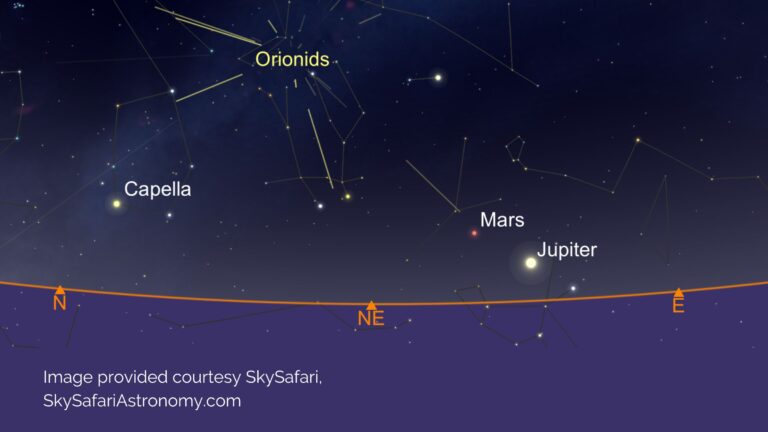
The Orionid meteor shower on 26 October at 3am AWST. Astronomical images provided by SkySafari, a Simulation Curriculum Company, All rights reserved www.simulationcurriculum.com.
A composite image of the Orionid meteor shower trails
Orionid trails. Image credit: Image credit: Mike Lewinski, Flickr.com.

The Orionid meteor shower lasts from 3 October to 7 November, peaking around 3am on 22 October 2026.

What to expect in 2026
This meteor shower lasts for over a month, slowly building up from a couple of meteors an hour to a peak of around 20 per hour. Rates were as high as double that in the early 2000s, so there’s a possibility they may spike again.

The Orionids are known as being very fast meteors, reaching speeds of around 66 km/s as they enter Earth’s atmosphere. While they’re faint meteors, they can leave lasting glowing trails behind them.

How to see the Orionid meteor shower
The radiant of the Orionids is between the constellations of Orion and Gemini on the north-east horizon.

With the peak of the meteor shower coming around 5am AWST, and Sunrise at 5.30am, your best time to see the Orionids will be in the hours before dawn on 22 October. The Moon is in its first quarter phase this year, setting around 8.45pm AWST the night before the Orionid shower’s peak.

More about the Orionid meteor shower
The Orionid meteor shower is caused by Earth flying through the debris field of dust, ice, and rocks left over from the tail of Halley’s Comet (or Comet 1/P Halley, to use its proper name.) While the shower was discovered by Europeans in 1798, it has been documented by Chinese astronomers for centuries.

Read more about the 2026 Orionids.

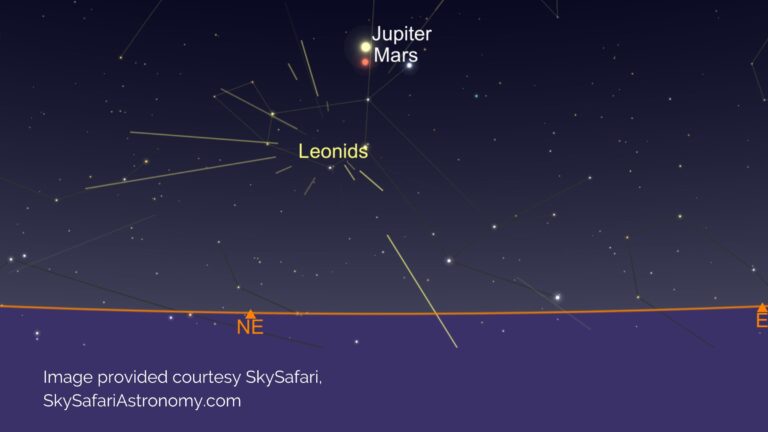
The Leonid meteor shower at 3am on 18 November, 2026. Astronomical images provided by SkySafari.
The Leonid meteor shower at 3am on 18 November, 2026. Astronomical images provided by SkySafari, a Simulation Curriculum Company, All rights reserved www.simulationcurriculum.com.
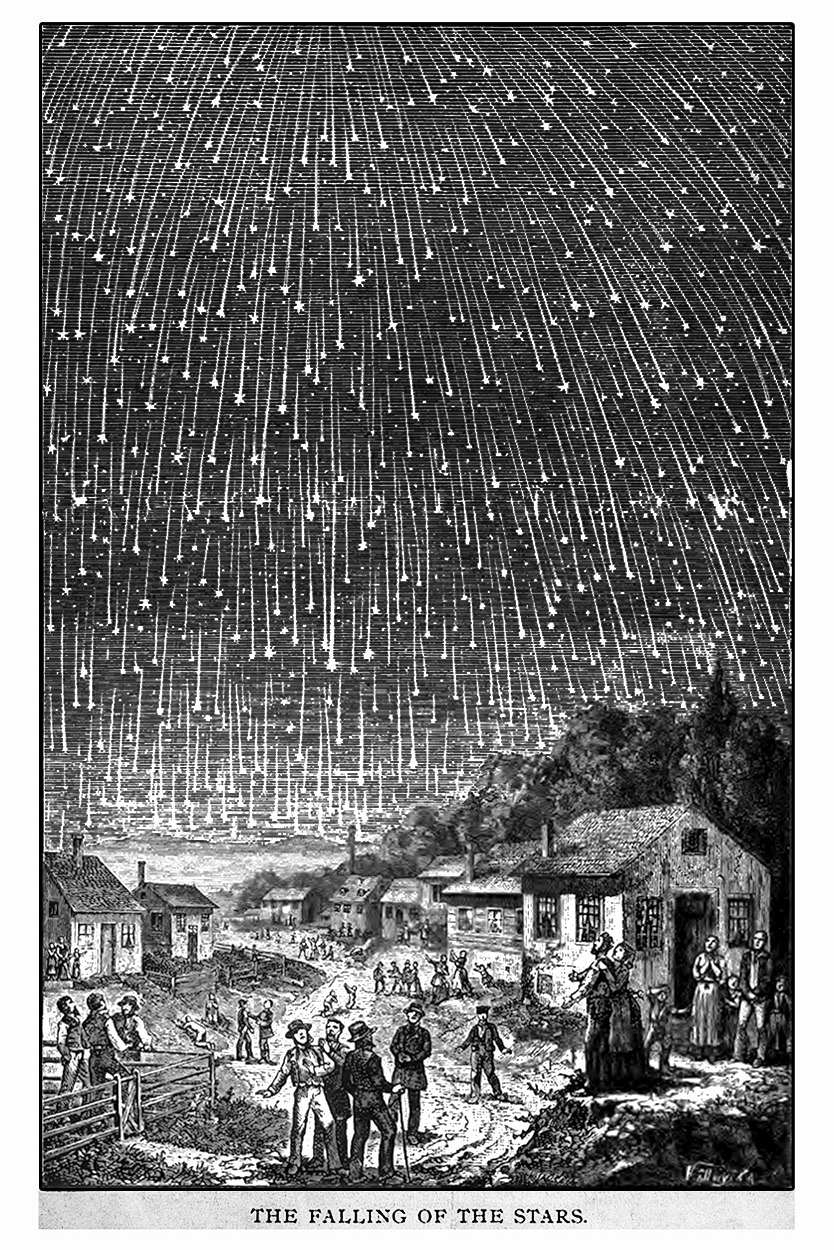
Engraved woodcut showing tens of thousands of meteors filling the sky.
An engraved depiction by Adolf Vollmy of the 1833 Leonid meteor shower.

The Leonid meteor shower lasts for most of November, with a sharp peak in the hours before dawn around 18 November 2026.

What to expect in 2026
The Leonids are bright and incredibly fast meteors, we’re talking speeds of 72km/s. They’re a fairly low-key shower and at their peak, you could see as many as 15 meteors an hour, but around every 33 years, the Leonids produce bursts of thousands of meteors per minute.

How to see the Leonid meteor shower
In the hours before dawn, look to the north-east horizon. The meteors seem to originate from the constellation of Leo, which will be low on the horizon.

This year, the Moon is in its first quarter and setting around 1am, so it won’t interfere with your meteor hunting.

More abut the Leonid meteor shower
The Leonids are caused by Comet 55P/Tempel-Tuttle, and when the Earth passes through a fresh deposit of debris every 33 years, it can result in a dramatic meteor storm.

In 1833, the Leonids frightened and amazed people across the eastern USA, as they witnessed tens of thousands of meteors per hour. Reports at the time described it as like “the planets and constellations were falling from their places.” The next Leonid storm is predicted for 2034, so put it in your diaries.

Find out more about the 2026 Leonid meteor shower.

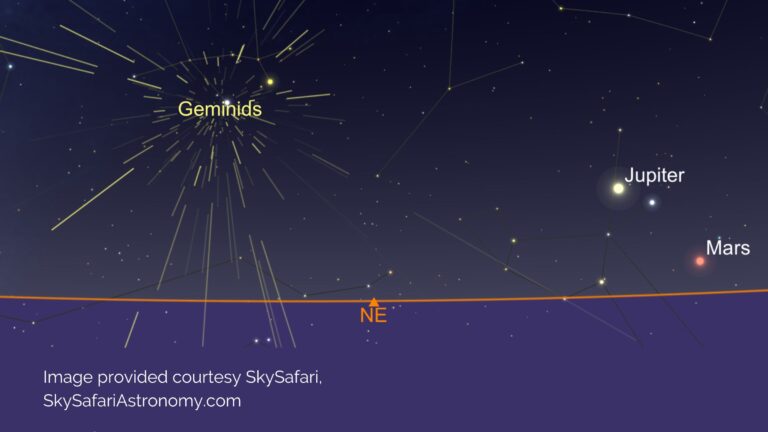
The Geminid meteor shower at mindight on 14/15 November, 2026. Astronomical images provided by SkySafari, a Simulation Curriculum Company, All rights reserved www.simulationcurriculum.com.
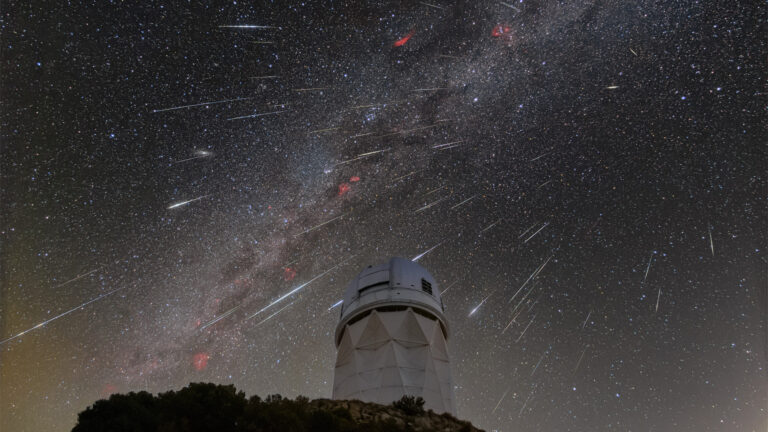
meteors from the Geminid meteor shower streak across the sky above an observatory
Meteors from the Geminid meteor shower streak across the sky. Credit: KPNO/NOIRLab/NSF/AURA/R. Sparks (NSF NOIRLab)

The Geminids meteor shower is one of the best meteor showers of 2026, peaking around 11pm on 14 December.

What to expect in 2025
The Geminids are particularly slow meteors, clocking in at around 35 km/s, but they’re famously bold and bright, and can produce colourful fireballs.

How to see the Geminids meteor shower
The radiant of the Geminids is the Gemini constellation, above the eastern horizon. The Moon will be in its first quarter and setting around 11pm, so you might want to wait until later for a potentially better view.

Because of some complicated physics, larger Geminid meteors are slowed down, and so brighter meteors can appear later than the peak. An added bonus of waiting is that later meteors are entering our atmosphere at a greater angle, and will be visible for longer and with longer tails.

At its best, and under ideal conditions, stargazers can hope for as many as 120 meteors per hour from the Geminids.

Read more about the 2026 Geminids here.

Grab your star charts, pack your sense of wonder, and head to the dark skies of an Astrotourism Town for a celestial adventure to catch one of the best meteor showers of 2026.

Keen to know what else is up this year? Check out our blog post on your best stargazing in 2026.

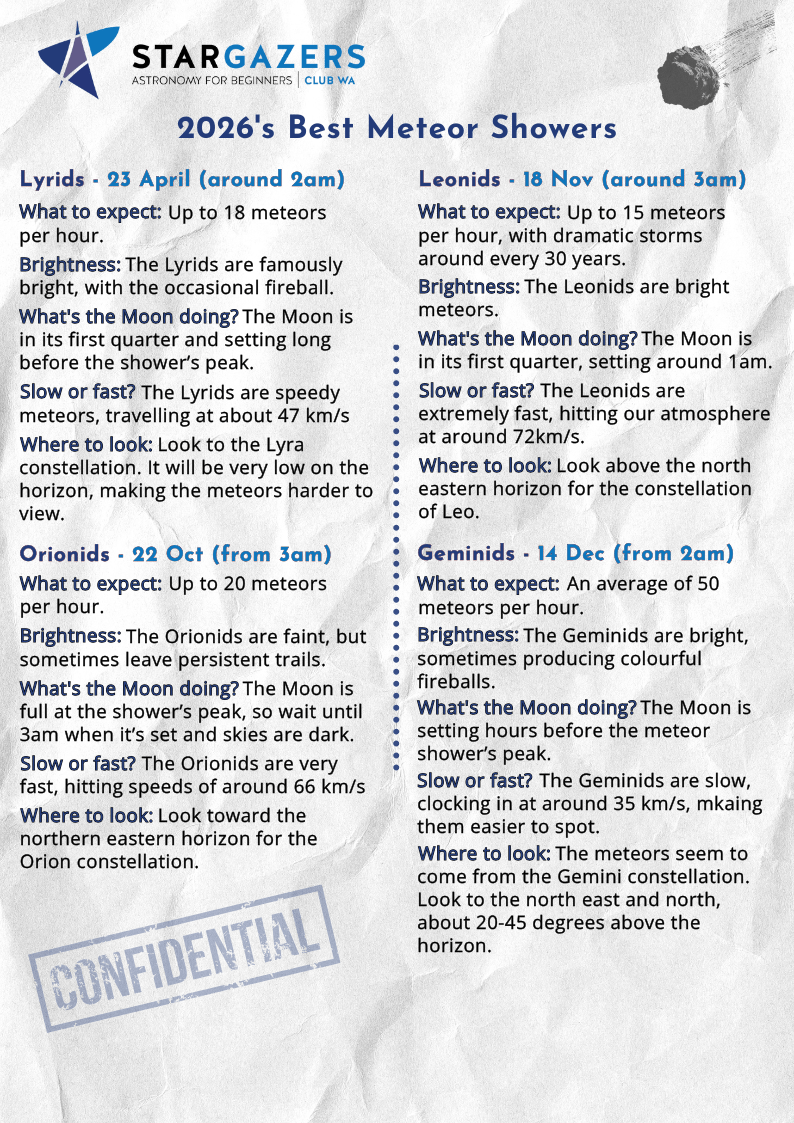
Image is a fact sheet detailing 2026's meteor showers. It is stamped 'confidential'
Download a free copy of our 2026 meteor showers fact sheet.
Jay Chesters

Jay Chesters

Jay Chesters is a wordsmith with a little bit of a thing for the stars.

As a cosmic storyteller with a love for astronomy and space that's out of this world, Jay’s always eager to share his knowledge and passions.

See the best meteor showers in astrotourism towns

Head to a dark sky town for some spectacular stargazing and an unforgettable astronomy experience in a welcoming local community.
Stargazers Club WA and Astrotourism WA acknowledge and pay tribute to the Traditional Custodians of Country throughout Western Australia. We recognise Aboriginal and Torres Strait people as the world's first astronomers and their continuing connection to lands, sky, waters and communities. We offer our respect to them, their cultures, and to Elders both past and present.