When you’re new to the world of stargazing, it’s tricky knowing how to choose your first telescope. Finding the best telescope for beginners is a delicate balance between different types of telescopes and how much you want to spend.
We’re going to cut through some jargon, and give you a few helpful tips to make choosing your first telescope easier, and have you seeing stars in no time.

The perfect beginner's telescope does exist
If someone told you there isn’t a perfect telescope, then someone lied.
Here’s the truth: the only perfect beginner’s telescope is the one that’s best for you and what you need.
Do you want a telescope for simple, casual stargazing, like looking at the Moon? You might want a telescope that’s simple to transport, quick to set up, and convenient to store.
Or are you a little more serious about your astronomy and want a telescope that’s more rewarding, even if it means more work? You might benefit from a larger, bulkier telescope that delivers you clearer views of faint, distant objects like nebulae, and galaxy structures?
To know how to find, choose, and buy your perfect first telescope, you need to know what you want to use your telescope for.

The benefits of refractor telescopes
When you’re choosing a telescope, you’ll see the refractor vs reflector question. The decision often comes down to getting the best aperture for your money.
Aperture is the telescope’s ‘light gathering potential’, so larger apertures see faint objects more clearly than telescopes with smaller apertures.
Refractor telescopes use glass lenses to collect and direct light. Astronomers like refractors for looking at the Moon’s surface, the planets, and especially for the sharp star images they give of bright double stars.
The downside is that lenses are more expensive to make than mirrors, so you’ll pay twice as much for a refractor telescope as for a reflector telescope with the same aperture.
Some cheaper refractor telescopes can give you ‘chromatic aberration’, where stars appear to have colourful fringes. This is because light’s wavelengths are focused into different spots; imagine a prism refracting light.
You can get special lenses or apochromatic telescopes to avoid this, but they also start getting expensive for your first telescope.
The advantages of reflector telescopes
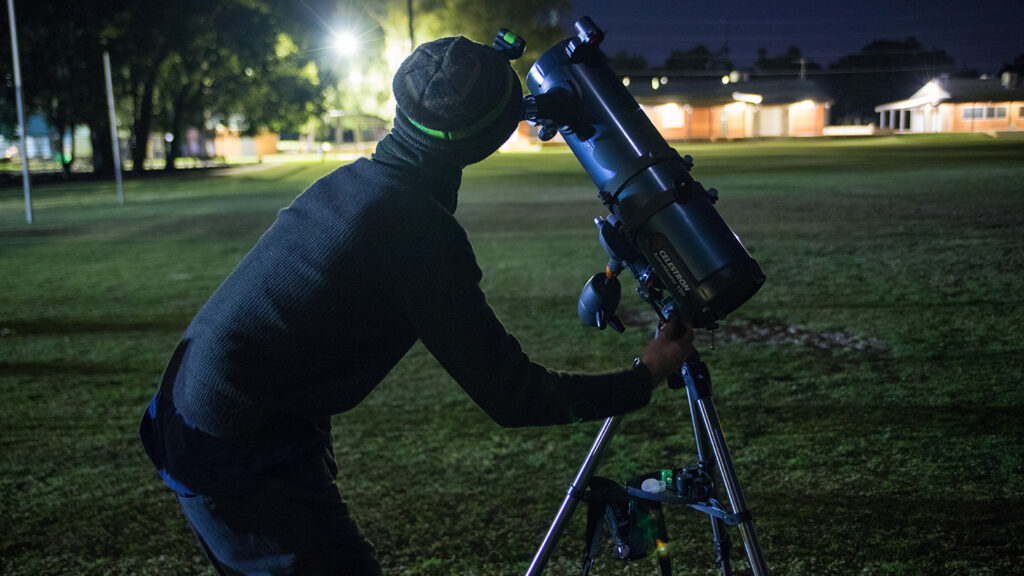
Reflector telescopes use mirrors, and the most common are Newtonian telescopes.
Isaac Newton’s design uses a large curved mirror that reflects incoming light towards a secondary mirror. The smaller, flat, secondary mirror then reflects the light to your eyepiece on the side.
To get the largest aperture for your money, a reflector telescope is the way to go, but they’re larger and bulkier, and require a little maintenance. Read more about that in our post Stargazing and the art of telescope maintenance.
While reflector telescopes are less portable than a refractor telescope, they’re a lot more cost effective, and for a little commitment they deliver so much more.

What reflector telescope is best for beginners?
A reflector telescope gives you the best aperture for your dollar, and we recommend Dobsonian telescopes. Dobsonians are Newtonian reflector telescopes mounted on a swivel base.
On the mount, your telescope tube moves up and down like a seesaw, while the base rotates. This helps to keep your telescope steady and smooth.
Place the stand down on flat ground, attach the telescope tube to the stand, and you’re all set.
Before you buy the largest telescope you can afford, consider how practical and portable it is. A Dobsonian telescope is much larger and bulkier than a refractor, especially with its mount.
Because of that, this isn’t a good beginner telescope for children or anyone with health issues or back problems.
Want expert advice? We get together every month for BYO Telescope Classes and Dark Sky Nights, where our astronomy guides are keen to share their advice on equipment you’re thinking of buying.

Does size matter to a telescope?
Telescopes are an instance where size does matter.
Size is not a question of how long the telescope tube is, or even the amount of magnification. It’s the size of the telescope’s optics that’s important.
For refractor telescope, the aperture is the diameter of the lens, and in reflector telescope, the aperture is the diameter of the telescope’s primary mirror.
The more light you have, the brighter and sharper the image you see will be when you increase magnification using different eyepieces.
For a reflector telescope, like a Dobsonian, the larger the diameter of the primary mirror, the larger the telescope’s aperture.
A 200mm mirror collects four times the amount of light of a 100mm mirror. NASA’s James Webb Space Telescope has a primary mirror that’s 6.5 meters across.
We recommend Dobsonians because you will pay the same amount for a 100mm refractor telescope as you will for a 200mm reflector telescope with four times the aperture.
Read more in our article Does size matter? 7 tips on what is the best telescope to buy for beginners.

Try stargazing using binoculars
A pair of binoculars is a great way to start stargazing. They’re simple to use and provide a different perspective of the night sky.
On the plus side, they’re very easy to use, lightweight, less expensive and have a wider field of view then telescopes, making it easier to find objects.
However, they don’t magnify objects as much as a telescope, so the images you see will be smaller.

Jay Chesters
Jay Chesters is an award-winning wordsmith and science communicator with a little bit of a thing for the stars.
A cosmic storyteller with a love for astronomy and space that's out of this world, Jay’s always eager to share his knowledge and passions.
you bought a telescope, how do you use it?
Come to a BYO Telescope Class or Dark Sky Night. Our astronomy guides are pleased to share their advice on any telescopes or equipment you have bought, or plan to buy.